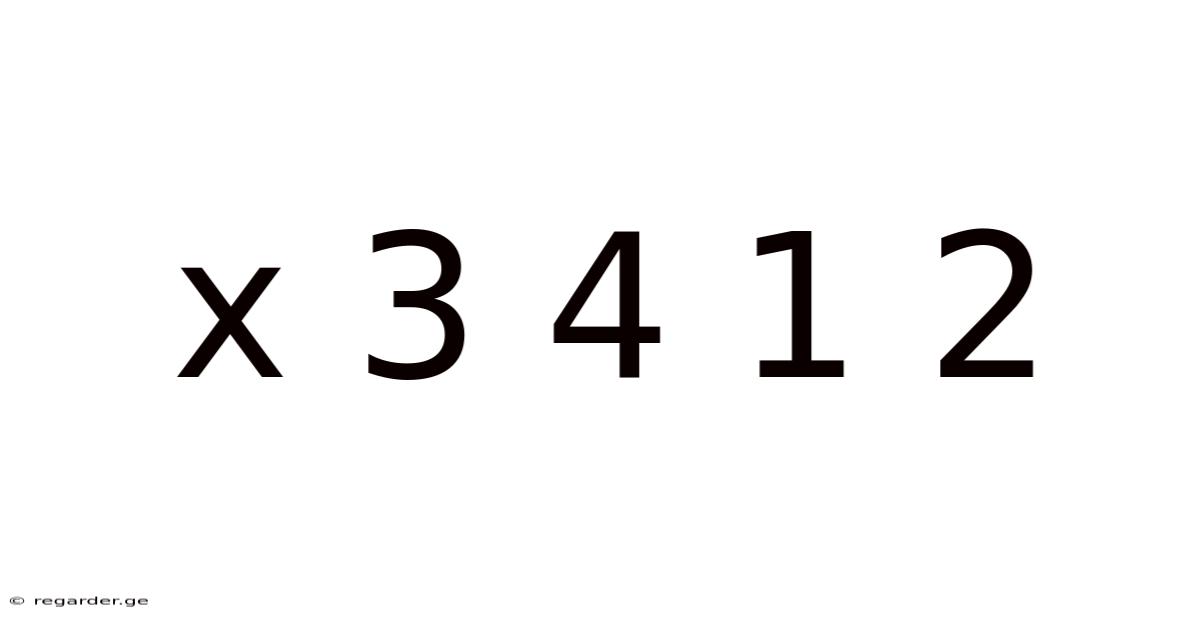
Decoding the Sequence: Exploring the Mysteries of "x 3 4 1 2"
This article digs into the enigmatic sequence "x 3 4 1 2," exploring its potential interpretations across various fields. We will examine mathematical, cryptographic, musical, and even literary perspectives, investigating possible meanings and underlying structures. The seemingly simple sequence offers a surprising depth of potential interpretations, highlighting the multifaceted nature of pattern recognition and problem-solving. This exploration will consider the role of "x" as a variable, potentially representing an unknown number or a placeholder for a broader concept Simple, but easy to overlook..
The Mathematical Perspective: Analyzing Numerical Relationships
From a purely mathematical standpoint, "x 3 4 1 2" presents several avenues for investigation. The presence of "x" immediately suggests an algebraic approach. The sequence could represent a partial series, a code, or even the result of a mathematical operation.
1. Solving for 'x': Potential Equations
We can attempt to find a mathematical relationship between the known numbers (3, 4, 1, 2) to deduce the value of 'x'. That said, without further context or information, multiple equations could potentially fit the sequence. For example:
-
Linear Progression: A simple linear progression is unlikely, as there's no consistent increment or decrement between the known numbers.
-
Quadratic or Higher-Order Equations: More complex polynomial equations could be constructed to fit the sequence, but these would require additional constraints or information to determine a unique solution for 'x' Easy to understand, harder to ignore. Worth knowing..
-
Modular Arithmetic: The sequence could represent remainders after division by a specific modulus. Here's a good example: if the sequence were part of a larger pattern involving modular arithmetic, we could explore potential relationships within a particular modulo system.
-
Recursive Sequences: The sequence might be defined recursively, where each term is a function of the preceding terms. Finding a recursive relationship could reveal a formula for 'x' and subsequent terms.
2. Analyzing Number Properties:
Beyond simple arithmetic, we can examine the properties of the numbers themselves. Consider the following:
-
Prime and Composite Numbers: The numbers in the sequence are a mix of prime (numbers divisible only by 1 and themselves) and composite (numbers divisible by more than just 1 and themselves) numbers. This might hint at a pattern involving the classification of numbers.
-
Factorization: Analyzing the prime factorization of each number could reveal hidden relationships or common factors, potentially shedding light on the sequence's structure.
-
Digital Roots: The digital root of a number is the iterative sum of its digits until a single-digit number is obtained. Here's one way to look at it: the digital root of 34 is 7 (3 + 4 = 7). Examining the digital roots of the numbers in the sequence might reveal a pattern Worth knowing..
The Cryptographic Perspective: Decoding a Hidden Message
The sequence "x 3 4 1 2" could potentially represent a simple substitution cipher or a more complex cryptographic code. The "x" could be a wildcard, an indicator of a missing character or key element in the cipher.
1. Substitution Ciphers:
In a simple substitution cipher, each number might correspond to a letter of the alphabet, a symbol, or a word. In real terms, without knowing the key (the mapping between numbers and their corresponding elements), decoding the message is challenging. "x" could represent a letter not yet assigned or a placeholder for a repeated element Simple, but easy to overlook..
Worth pausing on this one.
2. Polyalphabetic Substitution:
More complex ciphers, like the Vigenère cipher, use multiple alphabets to encrypt the message, adding another layer of complexity. If "x 3 4 1 2" is part of a larger sequence, it might represent elements in a polyalphabetic substitution scheme Simple, but easy to overlook..
3. Mathematical Ciphers:
Various mathematical techniques are used in cryptography. So the sequence could be the result of a modular arithmetic encryption, a linear congruential generator, or even a more sophisticated encryption algorithm. The "x" might be a key parameter in the encryption process.
Musical Interpretations: Rhythms, Scales and Melodies
The sequence "x 3 4 1 2" can be interpreted musically in various ways. We can consider it as representing:
-
Note Durations: The numbers can represent note durations (e.g., 3 eighth notes, 4 quarter notes, etc.) in a musical piece. 'x' could denote a rest or a note of indeterminate length.
-
Rhythmic Patterns: The sequence can be used to create a rhythmic pattern, influencing the beat and feel of a piece of music.
-
Musical Intervals: The numbers could represent intervals between musical notes on a scale or mode. The "x" could be a variable interval to be determined.
-
Chord Progressions: Within a specific musical key, the numbers could correspond to specific chords, forming a chord progression. The 'x' would again represent an unknown or variable chord It's one of those things that adds up..
Literary and Narrative Possibilities: Storytelling Through Numbers
Even in a literary context, "x 3 4 1 2" could hold symbolic meaning Not complicated — just consistent..
-
Coded Messages Within a Narrative: The sequence could be embedded within a story as a cryptic clue or riddle to be solved by the reader/character That's the part that actually makes a difference..
-
Symbolic Representation: Each number might symbolize a concept, character, or event within a narrative, with "x" representing an unknown element or a turning point Worth keeping that in mind..
-
Structural Elements: The sequence might influence the narrative's structure, representing chapters, scenes, or key moments in the storyline Simple, but easy to overlook..
Exploring the "x" Variable: Uncertainties and Interpretations
The variable "x" adds a layer of intrigue and complexity. Depending on the context, it could represent:
-
An Unknown Number: As discussed in the mathematical sections, it could be a solution to a mathematical equation or part of a larger number sequence.
-
A Missing Piece of Information: In cryptographic settings, "x" might represent a missing key or a piece of the puzzle necessary for decoding Easy to understand, harder to ignore. Took long enough..
-
A Variable Element: In musical or literary contexts, "x" could be a wildcard—a flexible element that can be assigned different values or meanings.
Conclusion: The Open-Ended Nature of Patterns
The sequence "x 3 4 1 2" presents a compelling puzzle with multiple potential solutions. Its interpretation depends heavily on the context and the lens through which it's examined. This ambiguity highlights the open-ended nature of pattern recognition and the potential for creative problem-solving. In real terms, while there's no single definitive answer, exploring the sequence through diverse disciplines provides valuable insights into mathematical reasoning, cryptographic techniques, musical structures, and narrative storytelling. But the exercise of deciphering "x 3 4 1 2" encourages a multidisciplinary approach, fostering critical thinking and creative exploration. Further investigation, with additional information or constraints, may lead to more precise interpretations Surprisingly effective..
Frequently Asked Questions (FAQ)
Q: Is there a single correct answer to decoding "x 3 4 1 2"?
A: No, the sequence is deliberately ambiguous, allowing for multiple interpretations depending on the context and the assumptions made Small thing, real impact..
Q: What is the significance of the "x" in the sequence?
A: The "x" represents an unknown variable or a missing element, adding a layer of complexity and requiring further investigation to determine its meaning.
Q: Can this sequence be used in real-world applications?
A: While the specific sequence might not have direct practical applications, the methods used to analyze it—such as mathematical modeling, cryptographic analysis, and pattern recognition—are crucial in numerous real-world fields, including computer science, security, and data analysis Which is the point..
Q: What other disciplines could this sequence be applied to?
A: The sequence could potentially be analyzed through the lens of game theory, computer programming (as a programming puzzle or data structure), or even in the context of designing visual patterns or algorithms Practical, not theoretical..
Q: How can I further explore this sequence?
A: Experiment with different approaches to solving for "x" mathematically, try different cryptographic techniques to see if you can decipher it as a code, or explore its potential interpretations within musical or literary contexts. The process of exploration is as valuable as any specific answer you might discover.
