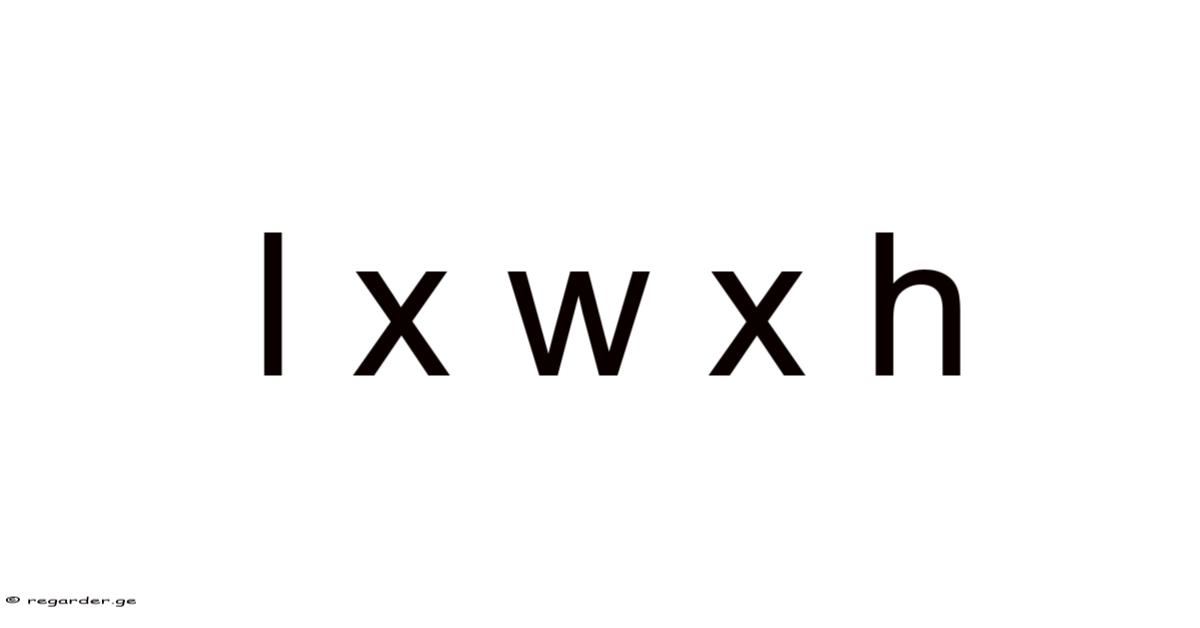
Understanding L x W x H: Volume Calculation and Its Applications
The formula L x W x H, representing length multiplied by width multiplied by height, is fundamental in calculating the volume of a rectangular prism or cuboid. Practically speaking, this seemingly simple equation has vast applications across numerous fields, from everyday tasks to complex engineering projects. Even so, this complete walkthrough will dig into the intricacies of this formula, exploring its practical applications, underlying mathematical principles, and addressing common misconceptions. Understanding L x W x H is key to solving various volume-related problems and appreciating the geometrical basis of three-dimensional shapes Surprisingly effective..
Real talk — this step gets skipped all the time.
Introduction: The Basics of Volume Calculation
Volume, in simple terms, refers to the amount of three-dimensional space occupied by an object. For regular shapes like a cube or a rectangular prism, calculating volume is straightforward. The formula L x W x H specifically applies to rectangular prisms, which are three-dimensional shapes with six rectangular faces where opposite faces are congruent and parallel. Each dimension – length (L), width (W), and height (H) – represents the extent of the object along each of its three perpendicular axes. These dimensions must be expressed in the same units (e.g., centimeters, meters, inches) for the calculation to be accurate.
The units of the resulting volume will be the cube of the chosen unit. As an example, if length, width, and height are measured in centimeters, the volume will be in cubic centimeters (cm³). Understanding this unit consistency is critical to avoid errors in calculations and interpretations.
Real talk — this step gets skipped all the time.
Step-by-Step Calculation: Applying the L x W x H Formula
Calculating the volume of a rectangular prism using the L x W x H formula is a simple three-step process:
-
Measure the Dimensions: Accurately measure the length (L), width (W), and height (H) of the rectangular prism. make sure all measurements are in the same units. Use appropriate measuring tools such as rulers, tape measures, or calipers depending on the size and precision required Practical, not theoretical..
-
Multiply the Dimensions: Multiply the length, width, and height together: Volume (V) = L x W x H. This step involves basic multiplication.
-
State the Result with Units: Express the calculated volume with the appropriate cubic units (e.g., cm³, m³, in³). This clearly indicates the unit of measurement used and avoids ambiguity.
Example: Let's say we have a rectangular box with a length of 10 cm, a width of 5 cm, and a height of 2 cm.
-
Step 1: L = 10 cm, W = 5 cm, H = 2 cm
-
Step 2: V = 10 cm x 5 cm x 2 cm = 100 cm³
-
Step 3: The volume of the box is 100 cubic centimeters.
Beyond the Basics: Understanding Irregular Shapes and Approximations
While L x W x H is perfect for rectangular prisms, many objects in the real world have irregular shapes. Still, for these, calculating the precise volume becomes significantly more complex. Approximation techniques often become necessary Easy to understand, harder to ignore..
-
Water Displacement: Submerging the object in a container of water and measuring the volume of water displaced provides an estimate of the object's volume. This method is particularly useful for irregularly shaped objects that are impermeable to water.
-
Geometric Approximation: Breaking down an irregular object into several smaller, more regular shapes (like rectangular prisms, cylinders, or spheres) and calculating the volume of each component separately. Summing the individual volumes provides an approximate total volume. This method requires careful estimation and judgement Less friction, more output..
-
Numerical Integration: For extremely complex shapes, advanced mathematical techniques such as numerical integration can be employed to calculate the volume. This approach utilizes computational methods to approximate the volume based on mathematical descriptions of the object's shape That's the whole idea..
The Mathematical Foundation: Derivation and Significance
The L x W x H formula is a direct consequence of the fundamental concept of volume. The number of unit cubes required to completely fill the prism along the length is equal to L, along the width is W, and along the height is H. So, the total number of unit cubes, and hence the volume, is given by the product L x W x H. Imagine filling the rectangular prism with unit cubes (cubes with sides of length 1 unit). This is a visual and intuitive way to understand the derivation of the formula. Its significance lies in its simplicity and wide applicability across various scientific and engineering disciplines.
Real-World Applications: From Packaging to Construction
The L x W x H formula has incredibly diverse applications across numerous fields:
-
Packaging and Shipping: Determining the volume of packages is crucial for optimizing shipping costs and ensuring efficient storage. Manufacturers put to use this formula to design appropriately sized boxes for their products, minimizing wasted space and maximizing efficiency.
-
Construction and Engineering: Volume calculations are fundamental in civil engineering, architecture, and construction. Estimating the volume of materials required for building foundations, walls, or filling spaces are all reliant on accurate volume calculations. This directly impacts material costs and project timelines Simple, but easy to overlook..
-
Agriculture: Understanding the volume of containers used for storing grains, liquids, or other agricultural products is crucial for inventory management and yield assessment. Accurate volume measurement ensures efficient resource allocation and helps in making informed decisions about production and storage.
-
Manufacturing: In manufacturing processes, the volume of materials is critical for controlling production parameters and ensuring consistent quality. The L x W x H formula has a real impact in designing molds, containers, and other manufacturing equipment And it works..
-
Medicine and Healthcare: The volume of liquids, such as medications or solutions used in medical procedures, needs precise measurement. Calculating the volumes of containers for storing or administering drugs relies on accurate volume calculations Simple, but easy to overlook. And it works..
-
Environmental Science: In environmental studies, volume estimations are crucial for understanding water flow in rivers, calculating the size of reservoirs, and assessing pollution levels. These accurate estimations are important for environmental management and conservation efforts Small thing, real impact. No workaround needed..
Frequently Asked Questions (FAQ)
Q: What happens if the units of measurement are inconsistent?
A: If the units of length, width, and height are not consistent (e.That said, g. , one is in meters, another in centimeters), the resulting volume calculation will be incorrect. Always make sure all dimensions are expressed in the same units before performing the calculation.
Q: Can I use this formula for any shape?
A: No, the L x W x H formula is specifically designed for rectangular prisms (cuboids). For other shapes, different formulas or approximation techniques are required Nothing fancy..
Q: How do I calculate the volume of a cube?
A: A cube is a special case of a rectangular prism where all sides are equal (L = W = H). So, the volume of a cube is calculated as V = L³.
Q: What if I have an object with a complex or irregular shape?
A: For irregular shapes, approximation techniques like water displacement, geometric approximation, or numerical integration are required to estimate the volume.
Q: Are there online calculators available to help with this calculation?
A: Yes, many online calculators are readily available for calculating the volume of rectangular prisms. Simply input the length, width, and height, and the calculator will provide the volume Small thing, real impact. Which is the point..
Conclusion: Mastering L x W x H and Beyond
The formula L x W x H, while seemingly basic, is a cornerstone of volume calculation for rectangular prisms. Understanding its limitations and knowing when to employ approximation techniques for irregularly shaped objects completes the picture. Practically speaking, mastering this formula is essential for anyone dealing with spatial measurements and volume calculations. In real terms, its applications are widespread, impacting various aspects of our daily lives and numerous scientific and engineering disciplines. Even so, by understanding both the theoretical underpinnings and practical applications of L x W x H, you gain a powerful tool for problem-solving in a multitude of contexts. This knowledge extends beyond simple arithmetic; it represents a fundamental understanding of three-dimensional geometry and its relevance to the world around us That's the part that actually makes a difference..
This is the bit that actually matters in practice Not complicated — just consistent..
