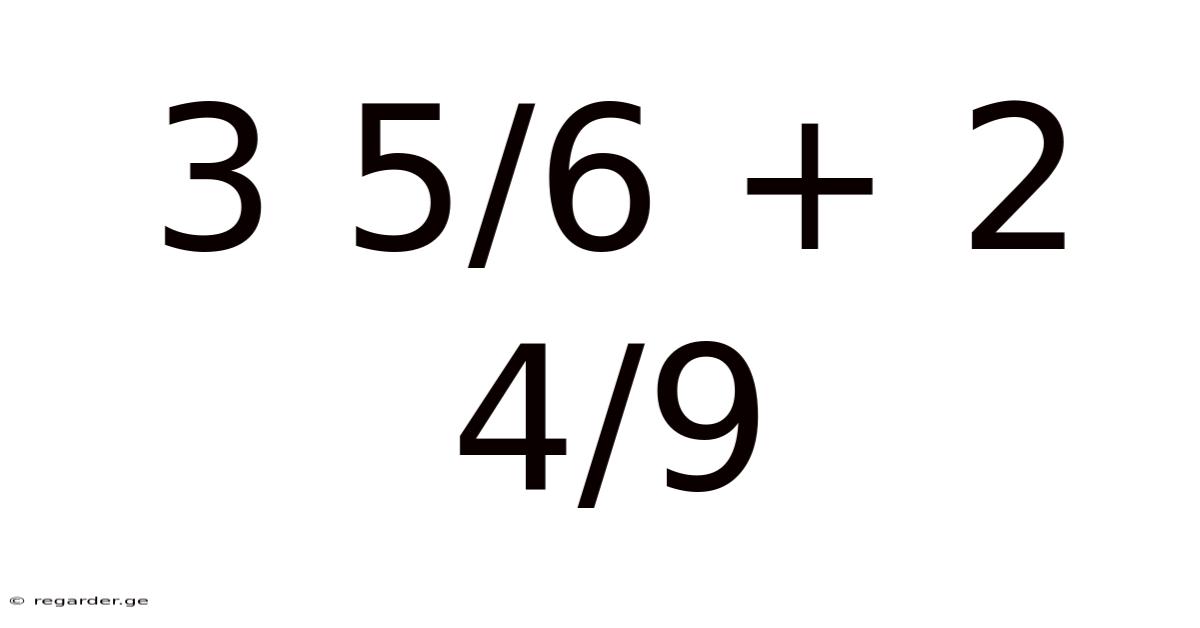
Mastering Mixed Numbers: A Deep Dive into 3 5/6 + 2 4/9
Adding mixed numbers might seem daunting at first, but with a structured approach and a solid understanding of fractions, it becomes a straightforward process. This practical guide will walk you through solving the equation 3 5/6 + 2 4/9, explaining each step in detail and exploring the underlying mathematical principles. Consider this: we'll cover the process, explore common pitfalls, and even look at some advanced concepts to solidify your understanding of fraction arithmetic. This guide aims to not just provide an answer but to empower you with the skills to confidently tackle any similar problem Easy to understand, harder to ignore..
Understanding Mixed Numbers
Before diving into the addition, let's refresh our understanding of mixed numbers. On top of that, a mixed number combines a whole number and a proper fraction (a fraction where the numerator is smaller than the denominator). Take this: 3 5/6 represents three whole units and five-sixths of another unit. Understanding this representation is crucial for performing arithmetic operations Easy to understand, harder to ignore..
Step-by-Step Solution: 3 5/6 + 2 4/9
The key to adding mixed numbers lies in finding a common denominator. This is a crucial step that allows us to add the fractional parts effectively. Let's break down the solution:
1. Find the Least Common Denominator (LCD):
The denominators in our equation are 6 and 9. To find the LCD, we need to identify the smallest number that is divisible by both 6 and 9. We can list the multiples of each number:
- Multiples of 6: 6, 12, 18, 24...
- Multiples of 9: 9, 18, 27...
The smallest number that appears in both lists is 18. That's why, our LCD is 18 But it adds up..
2. Convert Fractions to Equivalent Fractions with the LCD:
Now, we need to convert both fractions (5/6 and 4/9) into equivalent fractions with a denominator of 18. This involves multiplying both the numerator and the denominator by the same number:
-
For 5/6: To get a denominator of 18, we multiply both the numerator and denominator by 3 (since 6 x 3 = 18): (5 x 3) / (6 x 3) = 15/18
-
For 4/9: To get a denominator of 18, we multiply both the numerator and denominator by 2 (since 9 x 2 = 18): (4 x 2) / (9 x 2) = 8/18
3. Rewrite the Equation with Equivalent Fractions:
Our original equation, 3 5/6 + 2 4/9, now becomes:
3 15/18 + 2 8/18
4. Add the Whole Numbers and the Fractions Separately:
Now that we have a common denominator, we can add the whole numbers and the fractions independently:
- Whole numbers: 3 + 2 = 5
- Fractions: 15/18 + 8/18 = 23/18
5. Simplify the Result:
Our intermediate result is 5 23/18. Notice that the fraction 23/18 is an improper fraction (numerator is greater than or equal to the denominator). We need to convert this improper fraction into a mixed number:
23 divided by 18 is 1 with a remainder of 5. Because of this, 23/18 is equivalent to 1 5/18.
6. Combine the Whole Number and Fraction:
Finally, combine the whole number part (5) with the mixed number (1 5/18):
5 + 1 5/18 = 6 5/18
Because of this, the solution to 3 5/6 + 2 4/9 is 6 5/18.
Alternative Method: Converting to Improper Fractions
Another approach involves converting the mixed numbers into improper fractions before adding. This method can sometimes be more efficient, especially with larger mixed numbers Most people skip this — try not to. And it works..
1. Convert Mixed Numbers to Improper Fractions:
-
For 3 5/6: Multiply the whole number (3) by the denominator (6), add the numerator (5), and place the result over the denominator: (3 x 6) + 5 / 6 = 23/6
-
For 2 4/9: (2 x 9) + 4 / 9 = 22/9
2. Find the LCD and Convert to Equivalent Fractions:
The LCD of 6 and 9 is still 18. Convert the improper fractions:
- 23/6 becomes (23 x 3) / (6 x 3) = 69/18
- 22/9 becomes (22 x 2) / (9 x 2) = 44/18
3. Add the Improper Fractions:
69/18 + 44/18 = 113/18
4. Convert Back to a Mixed Number:
113 divided by 18 is 6 with a remainder of 5. So, 113/18 = 6 5/18
This method yields the same result: 6 5/18 The details matter here..
Common Mistakes to Avoid
- Forgetting to find the LCD: This is the most common error. You cannot add fractions directly unless they have the same denominator.
- Incorrectly converting fractions: Make sure you multiply both the numerator and the denominator by the same factor when creating equivalent fractions.
- Errors in simplifying improper fractions: Double-check your division when converting improper fractions to mixed numbers.
Further Exploration: Adding More Than Two Mixed Numbers
The principles discussed above apply equally well when adding more than two mixed numbers. Simply follow the same steps: find the LCD for all the fractions, convert to equivalent fractions, add the whole numbers and fractions separately, and simplify the result.
The Importance of Understanding Fractions
Mastering mixed numbers and fractions is fundamental to success in many areas of mathematics and science. It's a building block for more complex concepts such as algebra, calculus, and even geometry. A strong foundation in fractions will make learning these more advanced topics much easier Worth keeping that in mind..
Not obvious, but once you see it — you'll see it everywhere.
Frequently Asked Questions (FAQ)
Q: Can I add the whole numbers first and then the fractions?
A: While you can add them separately, it's crucial to have a common denominator before adding the fractions. Adding the whole numbers first doesn't change the need for a common denominator for the fractional parts Small thing, real impact..
Q: What if I get a different LCD?
A: As long as you find a common multiple of the denominators, you'll arrive at the correct answer, although the intermediate steps might look different. On the flip side, using the least common denominator (LCD) simplifies the calculations But it adds up..
Q: What if one of the fractions is already in the LCD form?
A: You only need to convert the fraction that does not have the LCD. The fraction already in the required form can be left as is.
Q: Are there other methods to add mixed numbers?
A: Yes, there are various approaches, but the methods outlined above (direct addition and converting to improper fractions) are generally the most efficient and widely used Small thing, real impact. And it works..
Conclusion
Adding mixed numbers might seem challenging initially, but by understanding the fundamental principles of fractions and following a systematic approach, it becomes a manageable and even enjoyable task. Practically speaking, remember the key steps: find the LCD, convert fractions to equivalent fractions, add the whole numbers and fractions separately, and simplify the result. Practice is key to mastering this skill, and with consistent effort, you'll build confidence and proficiency in solving fraction-related problems. This understanding will not only help you solve problems directly but will also form a strong base for further mathematical explorations.
