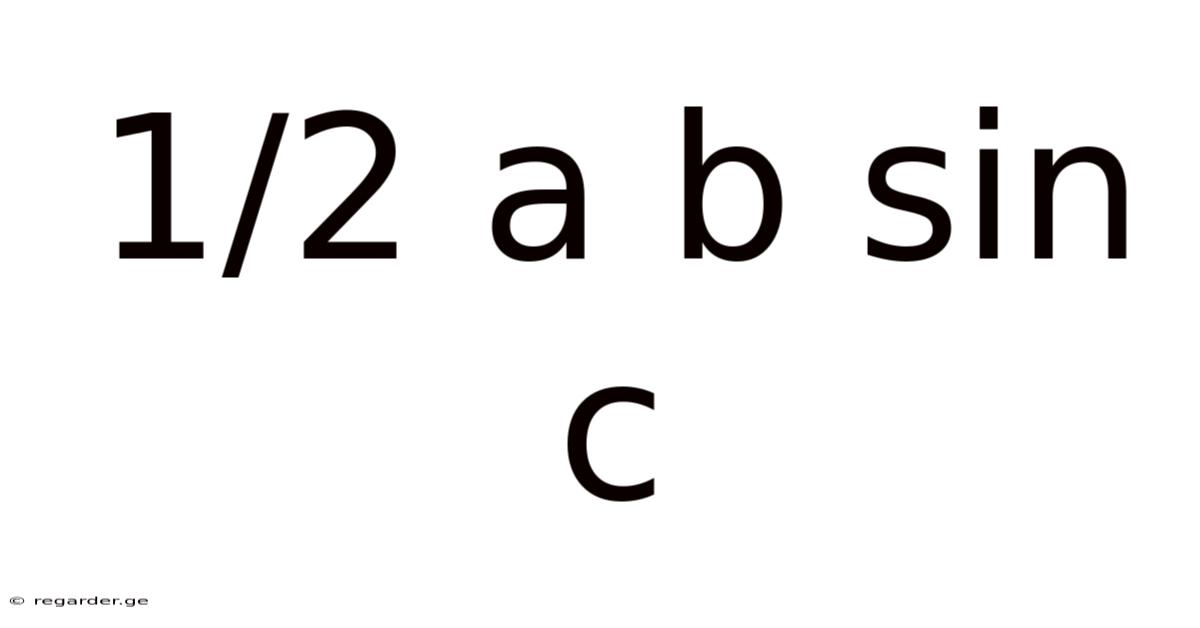
Decoding 1/2ab sin C: Understanding the Area of a Triangle
The formula 1/2 * a * b * sin C is a cornerstone of trigonometry, providing a powerful and elegant method for calculating the area of any triangle. Understanding this formula transcends simple memorization; it unlocks a deeper appreciation of the relationship between angles, sides, and area within triangles. This thorough look will dig into the formula's derivation, practical applications, and related concepts, ensuring a thorough understanding for students and enthusiasts alike Less friction, more output..
And yeah — that's actually more nuanced than it sounds Worth keeping that in mind..
Introduction: Why This Formula Matters
Determining the area of a triangle is a fundamental task in geometry and countless real-world applications. It offers a universal approach, allowing us to calculate the area of any triangle given the lengths of two sides (a and b) and the angle (C) between them. Worth adding: this is where the formula 1/2 * a * b * sin C steps in. Now, while the familiar formula, 1/2 * base * height, is readily applicable for right-angled triangles and those where the height is easily determined, it falls short when dealing with oblique triangles (triangles without a right angle). This versatility makes it indispensable in surveying, engineering, physics, and various other fields Nothing fancy..
Derivation of the Area Formula: Connecting Geometry and Trigonometry
The derivation of the 1/2 * a * b * sin C formula elegantly bridges the gap between geometry and trigonometry. Let's visualize a triangle ABC, where 'a' and 'b' represent the lengths of two sides, and 'C' is the angle between them.
-
Constructing the Height: Draw a perpendicular line from vertex B to side 'a', creating a right-angled triangle. Let's call the point where the perpendicular intersects side 'a' as 'D'. This perpendicular line represents the 'height' (h) of the triangle with respect to base 'a' Practical, not theoretical..
-
Trigonometric Relationship: In the right-angled triangle BDC, we can use trigonometry to express the height (h) in terms of side 'b' and angle 'C'. Specifically, we use the sine function: sin C = h / b. Rearranging this equation gives us: h = b * sin C It's one of those things that adds up..
-
Standard Area Formula: The area of any triangle is given by the standard formula: Area = 1/2 * base * height. In our case, the base is 'a' and the height is 'h' (which we've just expressed in terms of b and C).
-
Substituting the Height: Substitute the expression for 'h' from step 2 into the standard area formula: Area = 1/2 * a * (b * sin C) It's one of those things that adds up..
-
Final Formula: Simplify the equation to arrive at the final formula for the area of a triangle: Area = 1/2 * a * b * sin C.
Applying the Formula: Practical Examples
The formula’s power lies in its adaptability to various scenarios. Let's consider a few examples:
Example 1: A Simple Application
Suppose we have a triangle with sides a = 5 cm, b = 8 cm, and the angle between them C = 30°. To find the area, we plug the values into the formula:
Area = 1/2 * 5 cm * 8 cm * sin 30° = 10 cm²
Example 2: Solving for an Unknown Side
Imagine a situation where we know the area of a triangle (e.g., 20 square meters), one side (a = 10 meters), and the angle between the sides (C = 45°).
It sounds simple, but the gap is usually here.
b = (2 * Area) / (a * sin C) = (2 * 20 m²) / (10 m * sin 45°) ≈ 5.66 meters
Example 3: Real-World Application in Surveying
Surveyors often use this formula to determine the area of land plots. By measuring the lengths of two sides and the angle between them, they can accurately calculate the area without needing to physically measure the height.
Beyond the Formula: Understanding the Sine Function's Role
The sine function within the area formula is crucial. It effectively scales the area based on the angle C Small thing, real impact..
-
C = 90° (Right-angled Triangle): sin 90° = 1. The formula simplifies to Area = 1/2 * a * b, which is equivalent to 1/2 * base * height for a right-angled triangle.
-
0° < C < 90° (Acute Triangle): sin C is between 0 and 1. The area is less than 1/2 * a * b It's one of those things that adds up. No workaround needed..
-
90° < C < 180° (Obtuse Triangle): sin C is still between 0 and 1. The area is also less than 1/2 * a * b.
-
C = 0° or C = 180° (Degenerate Triangle): sin 0° = sin 180° = 0. The area is 0, indicating that the three points forming the triangle are collinear.
Extension to Other Area Formulas: Heron's Formula and Its Connection
While 1/2 * a * b * sin C is widely used, it's not the only way to calculate a triangle's area. Heron's formula provides an alternative approach, particularly useful when we know the lengths of all three sides (a, b, c) but not any angles.
Heron's formula utilizes the semi-perimeter (s), calculated as s = (a + b + c) / 2. The formula is:
Area = √[s(s-a)(s-b)(s-c)]
While seemingly different, Heron's formula and 1/2 * a * b * sin C are fundamentally interconnected. They both ultimately describe the same geometric property of the triangle—its area. The choice between them depends on the available information.
Frequently Asked Questions (FAQ)
Q: Can I use this formula for any type of triangle?
A: Yes, absolutely. The formula works for acute, obtuse, and right-angled triangles Most people skip this — try not to..
Q: What if I only know two sides and one angle, but it's not the angle between the two sides?
A: In this case, you cannot directly use the formula 1/2 * a * b * sin C. You'd need to use the sine rule or cosine rule to find the other necessary information (either the angle between the sides or the length of the third side) before applying the area formula.
Q: Are there any limitations to this formula?
A: The primary limitation is the need for at least two side lengths and the angle between them. If you lack this information, you'll need to use alternative methods. Also, ensure you're using consistent units throughout your calculations.
Q: How is this formula used in computer graphics?
A: The 1/2 * a * b * sin C formula is fundamental in computer graphics for rendering 2D and 3D shapes. Calculating the area of polygons (which can be broken down into triangles) is crucial for various tasks such as texture mapping, collision detection, and lighting calculations.
Conclusion: A Powerful Tool for Geometric Calculations
The formula 1/2 * a * b * sin C provides an elegant and powerful solution for calculating the area of any triangle. From simple calculations to complex applications in various fields, this seemingly straightforward formula remains a cornerstone of geometric understanding. Its derivation clearly illustrates the interplay between geometry and trigonometry, making it more than just a formula to memorize. But understanding this formula not only empowers you to solve various geometric problems but also deepens your appreciation of mathematical relationships within triangles. Its versatility and applicability make it an essential tool for students, professionals, and anyone interested in exploring the fascinating world of mathematics and its applications The details matter here. But it adds up..
